


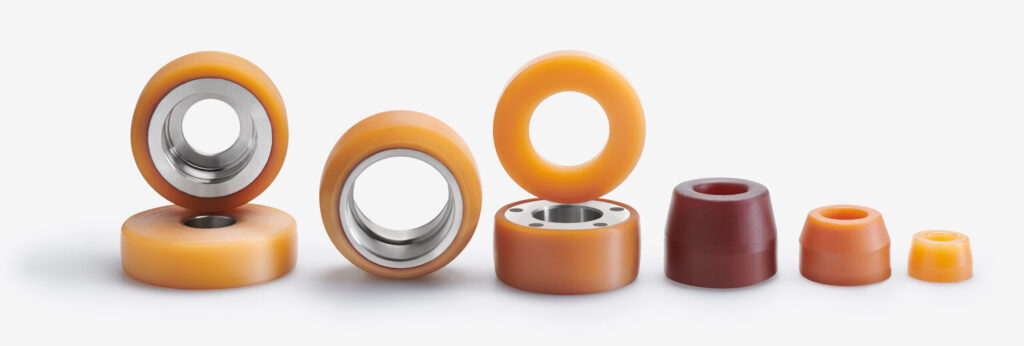
I. Origin
-Vulkollan® was invented in 1950 by Covestro.
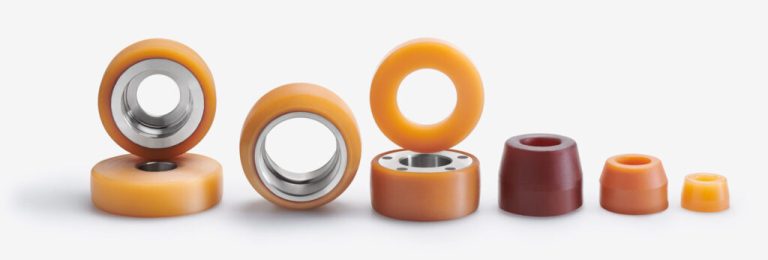
-Vulkollan is made from commercial isocyanate and polyester polyol and is cast (cast polyurethane elastomer) by licensed processors.
II. Hardness range
- The product is available in a hardness range from 65 Sh°A to 95 Sh°A.
– Its special mechanical properties are most pronounced in the hardness range from 80 Sh°A to 95 Sh°A.
III. Key properties
- A material with rubber-like elasticity; in its basic form it is a polyurethane elastomer based on 1,5-naphthalene diisocyanate, , polyester polyol and a special chain extender
– High dynamic load capacity, good resistance to UV, ozone, grease and oil, low temperature dependence, high abrasion resistance, low compression set, high rebound resilience and high tear resistance.
– High-performance polyurethane elastomer: Vulkollan® is a cast polyurethane (cast PU elastomer) based on 1,5-naphthalene diisocyanate, polyester polyol and a special chain extender, producing a material with rubber-like elasticity but far more mechanically and chemically durable.
– Outstanding dynamic load and impact resistance: Vulkollan withstands high dynamic stress, with low compression set and excellent rebound resilience, so wheels made from this material resist flattening and cracking under repeated loading.
– Excellent abrasion and tear resistance: Thanks to its special molecular structure, the material is 3–5 times more abrasion-resistant than standard PU and resists tearing and cutting well, making it suitable for rough surfaces or heavy loads.
– Wide environmental stability and chemical resistance: Vulkollan is little affected by temperature, withstanding –20°C to +80°C, and resists UV, ozone, oil, grease and mild chemicals, so it is suitable for both indoor and outdoor use.
– High friction and running performance: Vulkollan wheels have a good friction coefficient, resist slipping, run quietly, reduce vibration and protect floor surfaces.
– Versatile and long-lasting: Suitable for heavy-duty industrial wheels and casters, forklifts, AGVs and pallet trucks, especially where heavy loads, strong impacts, high speeds or continuous operation are involved.
IV. Practical applications
1. Heavy-duty industrial wheels and casters
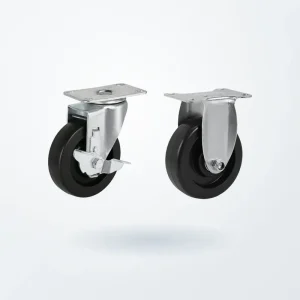
Vulkollan is commonly used for wheels on heavy-duty industrial equipment such as forklifts, high-capacity pallet trucks and warehouse tow tractors. Thanks to its outstanding load capacity and high elasticity, Vulkollan wheels do not flatten or deform under long-term loading, extending equipment life and reducing maintenance costs.
2. Wheels for AGVs and automated transport robots
Vulkollan is also well suited to wheels on AGVs (Automated Guided Vehicles) and industrial robots. With vibration damping, quiet running and floor protection, the material lets equipment run continuously at high speed while staying stable, minimizing damage to workshop floors and transported goods.
3. Wheels and casters for mechanical and manufacturing equipment
In factories for mechanical engineering, steel and aluminum processing, or conveyors, Vulkollan wheels are preferred for their strong impact resistance and high abrasion resistance. Their tear resistance keeps the wheels durable even on rough surfaces or in harsh working environments.
4. Wheels and casters for outdoor and special environments
Vulkollan withstands UV, ozone, oil, grease and mild chemicals, making it ideal for wheels used outdoors or in special environments. Its resistance to swelling and corrosion helps the wheels maintain performance and a long service life, reducing the risk of failure and replacement costs.
5. High-speed wheels and casters
For fast transport equipment, automated machines or high-speed pallets, Vulkollan helps wheels generate less heat, maintain good friction and reduce vibration. This not only protects floors and goods but also keeps equipment running safely, efficiently and reliably over the long term.
Technical Data
Blickle Softhane
Vulkollan ®
Lmax
Hardness (Shore A)
Hardness (A)
75
92
97
NBS Abrasion Index
Abrasion resistance (mm3)
45
40
300
Bashore Resilience
Resilience (%)
57
52
44
Rolling resistance
Rolling resistance (%)
1,0
0,9
–
Tensile Strength
Tensile strength (N/mm2)
44
50
33,10
Break the stretch
Elongation at break (%)
520
615
335
Maximum speed
Maximum speed (km/h)
16
25
–