




Understanding ball screws (Ball Screw)
1. Definition
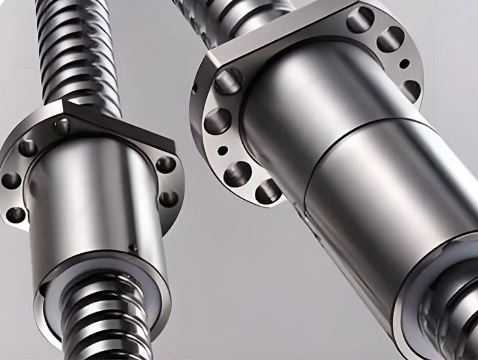
A ball screw (Ball Screw) is a mechanical drive mechanism that converts rotary motion into linear motion, or vice versa, via recirculating balls between the screw shaft and the nut.
Compared with a conventional lead screw, a ball screw is far more efficient thanks to rolling friction instead of sliding friction.
2. Basic construction
A ball screw assembly usually consists of 3 main parts
–
Screw shaft (Screw Shaft): has precision helical grooves (groove) for the balls to roll in.
–
Nut (Nut): contains grooves that mate with the screw shaft and a ball return mechanism (return system) that keeps the balls recirculating continuously.
–
Balls (Balls): hardened steel balls between the screw and the nut that create rolling friction.
There are also accessories such as dust seals, ball return tubes and protective covers.
3. Operating principle
When the screw shaft rotates, the balls roll in the grooves between the screw and the nut, converting torque into linear force. After reaching the end of the groove, the balls are returned to the starting position by the ball return system, forming a closed loop.
4. Advantages
–
High efficiency (90–98%) thanks to rolling friction.
–
High accuracy with minimal error, suitable for CNC machines, robots and measuring/inspection machines.
–
High load capacity and long service life thanks to even force distribution across the balls.
–
Smooth motion with low noise (depending on ball type and accuracy grade).
5. Applications
Ball screws are widely used in
–
CNC machine tools (turning, milling, grinding, EDM).
–
Measuring machines, semiconductor equipment, industrial robots.
–
Precision drive systems: 3D printers, laser cutters, medical equipment.
–
Automation technology, linear motion.
6. Classification
There are many ways to classify ball screws; common ones include
–
By ball return system: tube return (return tube), internal return (internal return), end cap return (end cap return).
–
By accuracy: grades C0–C10 (per JIS); grades C0, C1 and C3 are commonly used for high-precision CNC.
–
By load: light, medium and heavy load types.
7. Maintenance and usage notes
–
Lubricate regularly to reduce wear and prevent ball jamming.
–
Install in alignment to avoid misalignment that causes vibration and shortens service life.
–
Protect from dust and dirt with seals, bellows or spring covers.
–
Choose the correct accuracy grade and load rating for the application.
Conclusion
The ball screw (Ball Screw) is a key component in modern linear motion.
With its advantages in accuracy, efficiency and durability, it has increasingly become an indispensable solution in mechanical and automation systems.