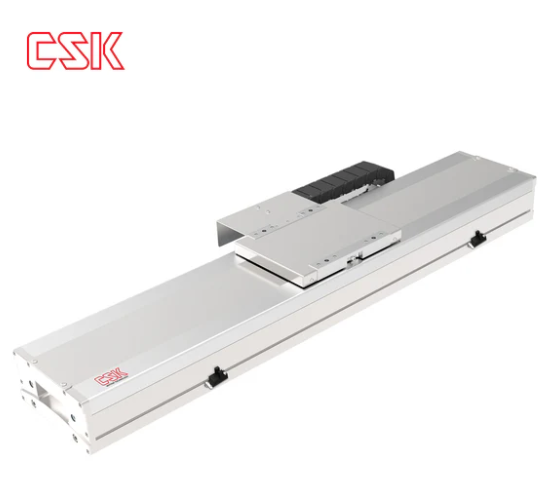




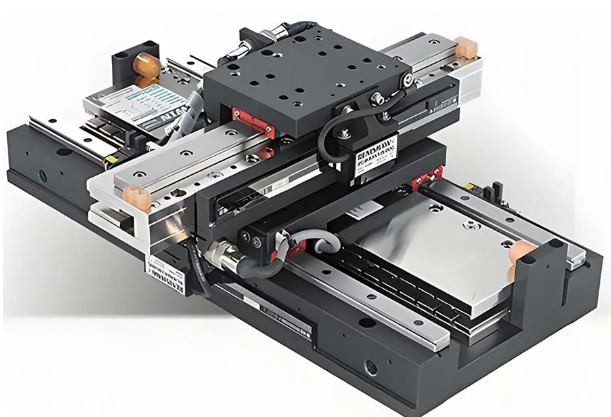
A linear motor is a motor that converts electrical energy directly into linear motion. Linear motors are widely used in automation, robotics, precision machining and other fields. Compared with traditional rotary motors, linear motors offer a simple structure, fast response and high control accuracy. To get the full performance out of a linear motor, the right control method is especially important. This article introduces several common linear motor control methods, including PID control, fuzzy control, sliding mode control and adaptive control.
1. PID control
PID (proportional-integral-derivative) control is a classic feedback control method widely used in industrial control systems. In linear motor control, the PID controller adjusts the input signal to achieve the desired motion state by tracking the motor’s position, speed and acceleration in real time.
1.1 Principle
A PID controller consists of three parts
Proportional control (P): Adjusts according to the current error (the difference between the target position and the actual position). The larger the error, the stronger the control action.
Integral control (I): Accumulates past errors, eliminating steady-state error and ensuring the system finally reaches the target position.
Derivative control (D): Predicts the trend of error change, providing predictive control and reducing overshoot and oscillation.
1.2 Advantages and disadvantages
Advantages: Simple and easy to implement, suitable for most linear systems, and can effectively improve system stability and response speed.
Disadvantages: For nonlinear and time-varying systems, PID performance may not be ideal, and parameter tuning is relatively complex.
2. Fuzzy control
Fuzzy control is a control method based on fuzzy logic, suitable for handling uncertain and nonlinear problems. In linear motor control, the fuzzy controller derives its control output through fuzzy rules and can respond effectively to dynamic changes in the system.
2.1 Principle
A fuzzy controller mainly consists of four parts: fuzzification, a rule base, an inference mechanism and defuzzification. First, the input variables (such as position error and speed error) are fuzzified; inference is then performed according to preset fuzzy rules, and finally the output is defuzzified to obtain the control signal.
2.2 Advantages and disadvantages
Advantages: Does not require an exact mathematical model, can handle complex and uncertain systems, and is highly adaptable.
Disadvantages: Experience is needed to design the fuzzy rules, system performance depends on the quality of the rule base, and debugging can be complex.
3. Sliding mode control
Sliding mode control is a robust control method that can effectively handle uncertainty in system parameters and external disturbances. Its core idea is to control the system by designing a sliding surface so that the system state slides along it.
3.1 Principle
The sliding mode control design process usually involves two steps
Sliding surface selection: Choose a suitable sliding surface so that the system state can slide along it.
Control law design: Design the control law so that the system state remains stable on the sliding surface and quickly reaches the target state.
3.2 Advantages and disadvantages
Advantages: Highly robust to system parameter changes and external disturbances, and suitable for high-precision control applications.
Disadvantages: Frequent control switching can cause "chattering", and the design process is relatively complex.
4. Adaptive control
Adaptive control is a control method that automatically adjusts control parameters according to dynamic changes in the system and is suitable for systems with uncertain or changing parameters.
4.1 Principle
An adaptive control system usually consists of two parts
Controller: Generates the control signal based on the current system state.
Adaptation mechanism: monitors system performance in real time and adjusts controller parameters according to set performance indicators.
4.2 Advantages and disadvantages
Advantages: Able to cope with changes in system parameters and suitable for complex and uncertain control environments.
Disadvantages: Design and implementation are relatively complex and may require significant computing power.
5. Other control methods
In addition to the methods above, other advanced control strategies can also be used for linear motor control, such as neural network control and model predictive control (MPC). These methods often combine modern control theory with machine learning to further improve control accuracy and system performance.
Conclusion
In practice, choosing the right control method requires a comprehensive assessment of the specific system requirements, performance indicators and environmental conditions. With continuous technological progress, linear motor control methods will become smarter and more efficient, driving automation and precision across many industries.